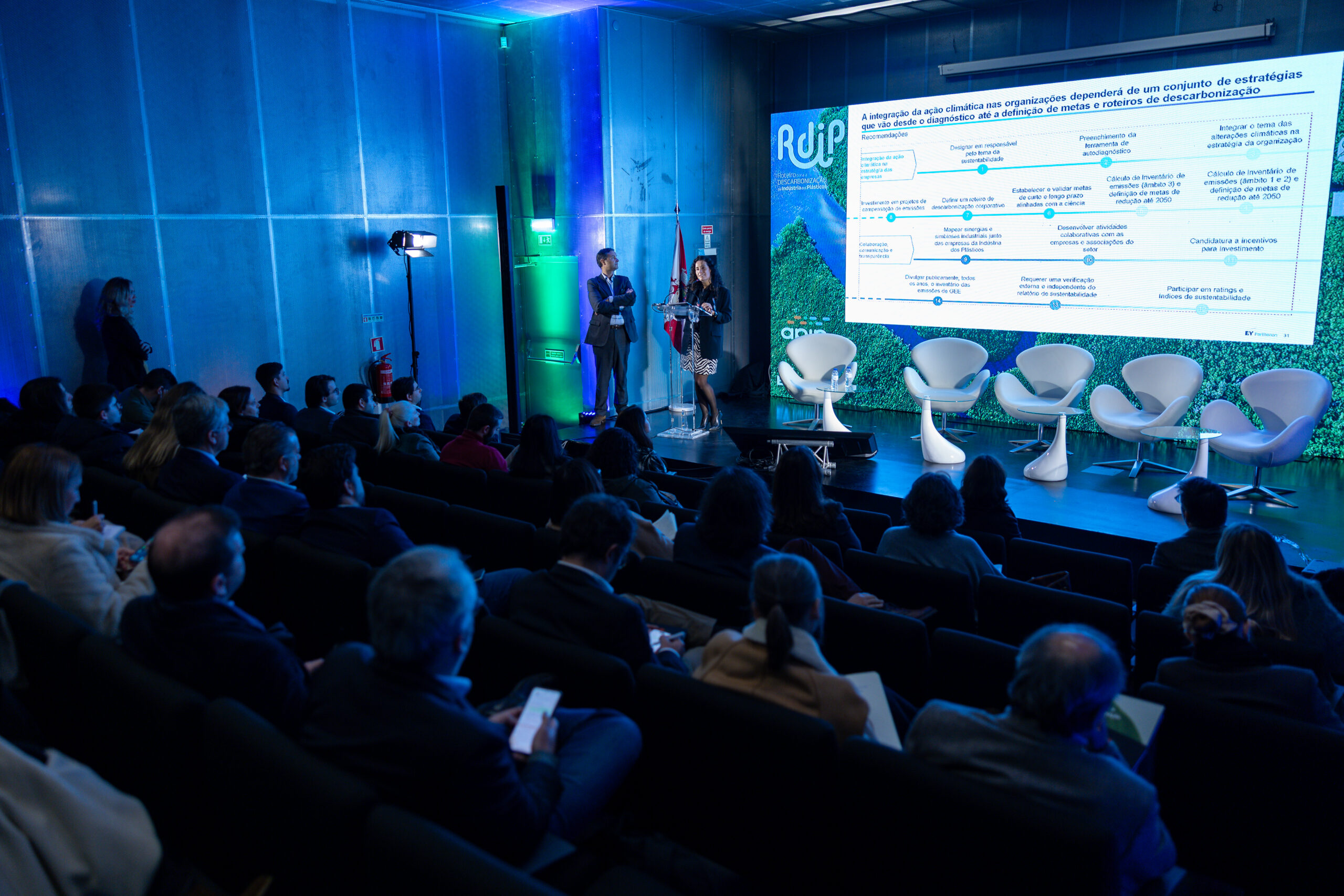
The Public Session for the Presentation of the Results of the RDIP – Roadmap for the Decarbonization of the Plastics Industry took place yesterday, in an atmosphere marked by knowledge sharing, strategic vision, and a firm commitment to the sustainable transformation of the sector.
Promoted by APIP – Portuguese Plastics Industry Association, with the support of EY, under the PRR – Recovery and Resilience Plan, the RDIP asserts itself as a structuring instrument to guide the industry towards carbon neutrality.
The event brought together various experts, public entities, companies, and representatives from academia, who contributed to a rich and multidisciplinary debate on the sector’s climate future.
Summary of RDIP Results
The presentation of the RDIP allowed the main conclusions of this pioneering work to be disseminated, establishing a clear path for the decarbonization of the plastics industry by 2050.
Sector Characterization and Initial Diagnosis
- The industry comprises more than 1,000 companies, responsible for €7 billion in turnover and more than 27,000 jobs.
- Direct and indirect emissions (Scopes 1 and 2) have fallen by 29% since 1990, despite the sector’s economic growth over the same period.
- The sector shows a high propensity for innovation, especially in initiatives with environmental benefits, such as energy efficiency and material substitution.
Decarbonization Trajectories by 2050
Two main scenarios were developed:
1. Business as Usual (BAU) Scenario
This scenario predicts a slowdown in emissions growth, but does not allow carbon neutrality to be achieved, with significant emissions remaining in 2050.
2. Carbon Neutrality Scenario
This sets out the path to achieving reductions of 93% to 100% in emissions in the subsectors analyzed (CAE 2016 and CAE 222), using multiple decarbonization vectors such as:
- Energy efficiency
- Electrification
- Renewable fuels
- Carbon capture and storage technologies
- Mechanical and chemical recycling
- Reuse and eco-design
- Use of alternative and circular feedstocks
Strategic Drivers of Transformation
The analysis identifies two major strategic axes for the transition:
1. Decarbonization of Production
This includes efficiency improvements, technological modernization, electrification of processes, and incorporation of renewable energy.
Energy efficiency stands out as a “fast and cost-effective” vector, valued by about 100% of the companies surveyed.
2. Promotion of Circularity
Based on:
- Advanced recycling (mechanical and chemical)
- Reuse
- Ecodesign
- Replacement with circular and bio-based plastics
This axis will become particularly relevant from 2030 onwards, as the technologies reach industrial maturity.
Critical Factors and Recommendations
The success of the implementation of these measures will depend on financial, regulatory, technological, and market factors. Among the recommendations, the following stand out:
- Integration of climate action into corporate strategy
- Annual calculation and reporting of emissions
- Setting scientific targets
- Creation of corporate decarbonization roadmaps
- Application for financial incentives
- Promotion of industrial symbiosis
- Training and professional qualification programs, at a time when green skills are in growing demand in the European market
APIP would like to thank EY, the Advisory Board, moderators, speakers, and participants for their valuable contribution to the development and validation of this Roadmap.
The RDIP does not end a cycle: it starts a new one. It is a living instrument that will continue to guide decisions, mobilize companies, and drive the sustainable transition of the plastics industry towards 2050.