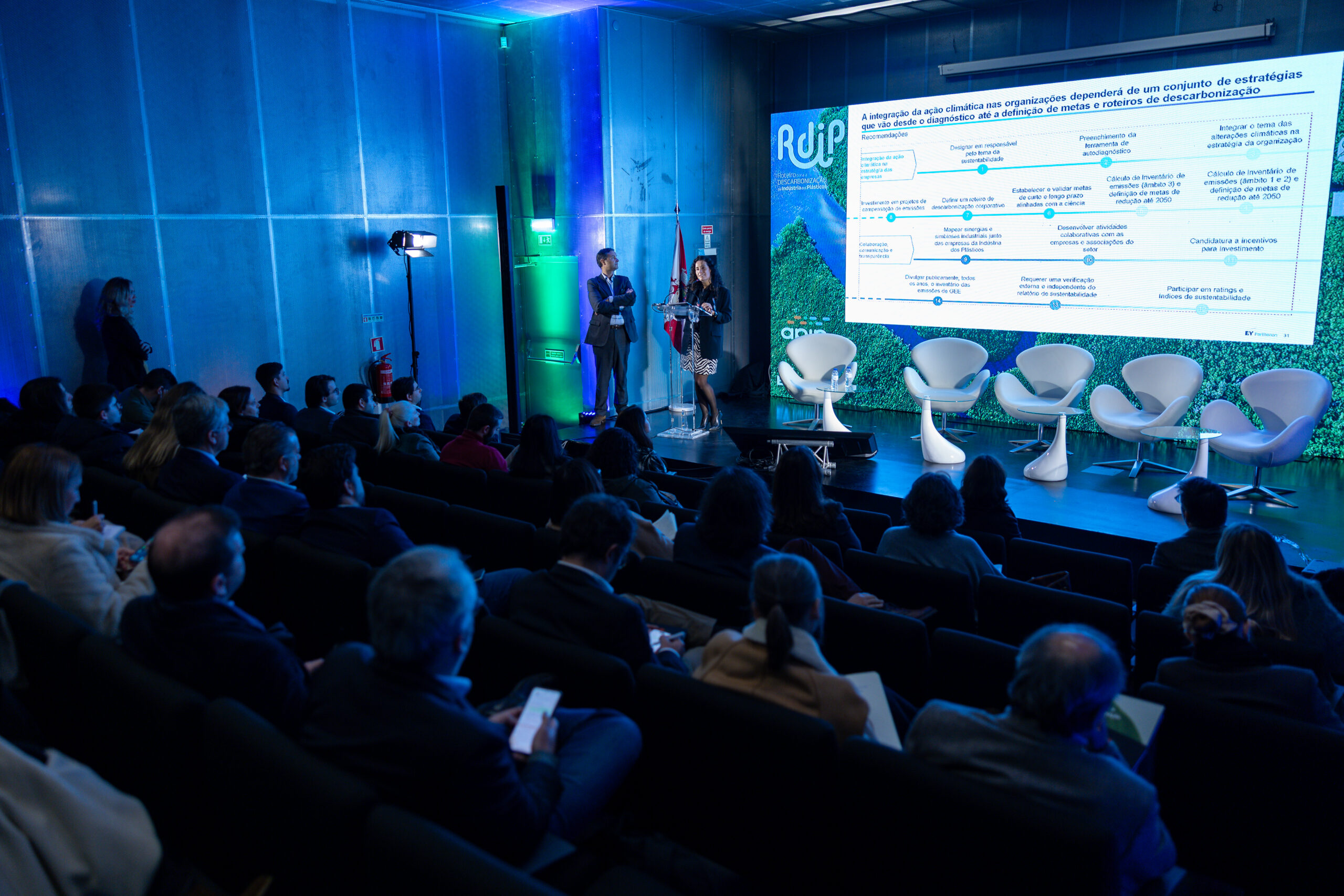
On 2 and 17 October 2024, the Strategic and Scientific Committees of the RDIP Advisory Board met for further working sessions, organised by APIP in partnership with EY, and co-funded by the PRR – Recovery and Resilience Plan.
These meetings, attended by representatives from academia, industry and sustainability experts, aimed to analyse the preliminary results of the sector’s economic, social and environmental characterisation, and to debate the assumptions and decarbonisation scenarios to be considered up to 2050.
The Strategic Committee session (2 October) focused on the main strategic pillars and decarbonisation levers, including regulatory trends, public policy instruments, and the role of innovation and circular economy in boosting competitiveness. It also examined emission-reduction trajectories and the challenges linked to renewable-energy integration, process electrification and waste valorisation.
The Scientific Committee session (17 October) concentrated on the technical validation of emission models and scenarios, highlighting that direct and indirect emissions (Scopes 1 and 2) from the sector account for approximately 2.4% of national emissions and 9% of the manufacturing industry’s total. The Committee discussed technological decarbonisation factors, such as energy efficiency, circularity and carbon management, and provided recommendations to refine the sectoral pathways towards carbon neutrality. These meetings represented a decisive step in developing the Roadmap for the Decarbonisation of the Plastics Industry, consolidating an integrated, collaborative vision for the sector’s climate transition, and reaffirming the industry’s commitment to innovation, sustainability and carbon neutrality by 2050.